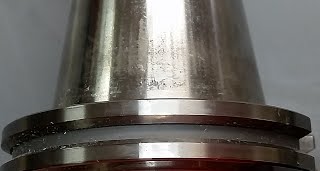
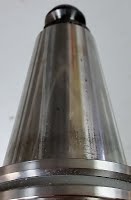
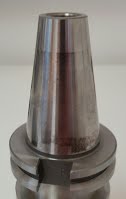
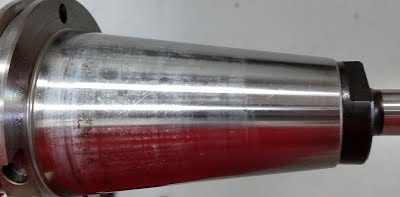
Taper Damage from Fretting
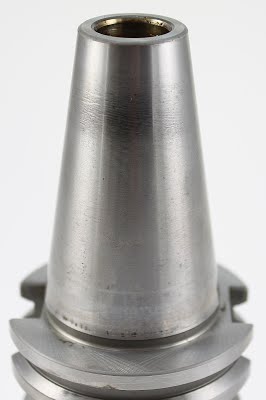
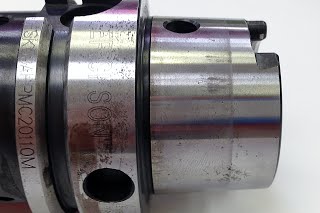
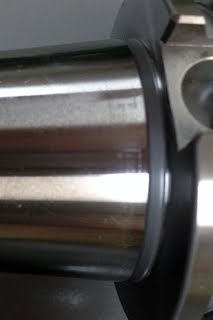
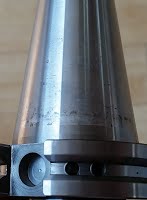
In a tool holder, fretting occurs when the taper is pulled to the point of disengagement. The pull-out creates a "dog-tail" effect, where the holder contacts the spindle at the top and bottom of the taper. Depending on the operation, witness marks appear as radial rings and/or straight lines along the taper.
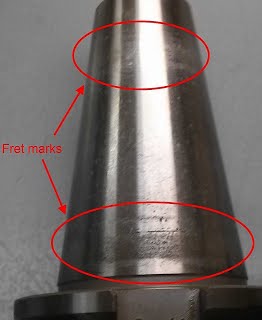
The tool holder can grip the cutter strongly enough to be pulled from the machine. When a cutter and holder experience fretting, tool life and part finish are dramatically reduced.
Primary Causes
- Weak or worn drawbar disk springs
- Programmed load greater than drawbar force
- High-helix cutter flutes (over 30 degrees) or cutters designed to create negative Z-axis pressure
Why It Happens
Cutter manufacturers' feed rates do not account for drawbar strength. Customers may push cutters at or above 100% load, exceeding spindle retention strength (draw force).
- BT30 spindles: approximately 800 ft/lbs of draw force
- CAT40: 1,300-2,200 ft/lbs
- CAT50: 6,000+ ft/lbs
If you run a cutter in a BT30 spindle at the same feed rate or spindle load as in a CAT50 spindle, the drawbar retaining the tool holder may not handle the load.
To Prevent These Issues
- Check and maintain consistent draw force. Your machine manufacturer can test the spindle, or you can purchase a gauge.
- Program for the machine, not just the cutter.
Proper programming for the machine tool can eliminate fretting and improve tool life.